
Neshoba County Court Records After Arrest
The local arrest-to-court path starts with booking and first appearance. The official Neshoba County Justice Court page says traffic tickets from the State Highway Patrol and Sheriff's Department, led locally by Sheriff Eric Clark, DUIs, county ordinances, and early felony steps are handled in Justice Court. It also says all felony cases are first heard there for initial appearance and filing of affidavit. Judges hold court sessions at the jail so each arrested person receives an initial appearance within three days of arrest.
That first appearance is not the same thing as a conviction. The booking side belongs with custody and jail records, so current inmate status belongs with Neshoba County jail inmate records. Booking photos belong with Neshoba County jail mugshots. Court records after a jail arrest focus on the charging documents, docket entries, hearing dates, bond orders, bench warrants, motions, pleas, trials, dismissals, and judgments that follow the arrest.
The official Justice Court source is the local anchor because it describes the jail-session practice and the first-appearance role after a Neshoba County arrest.
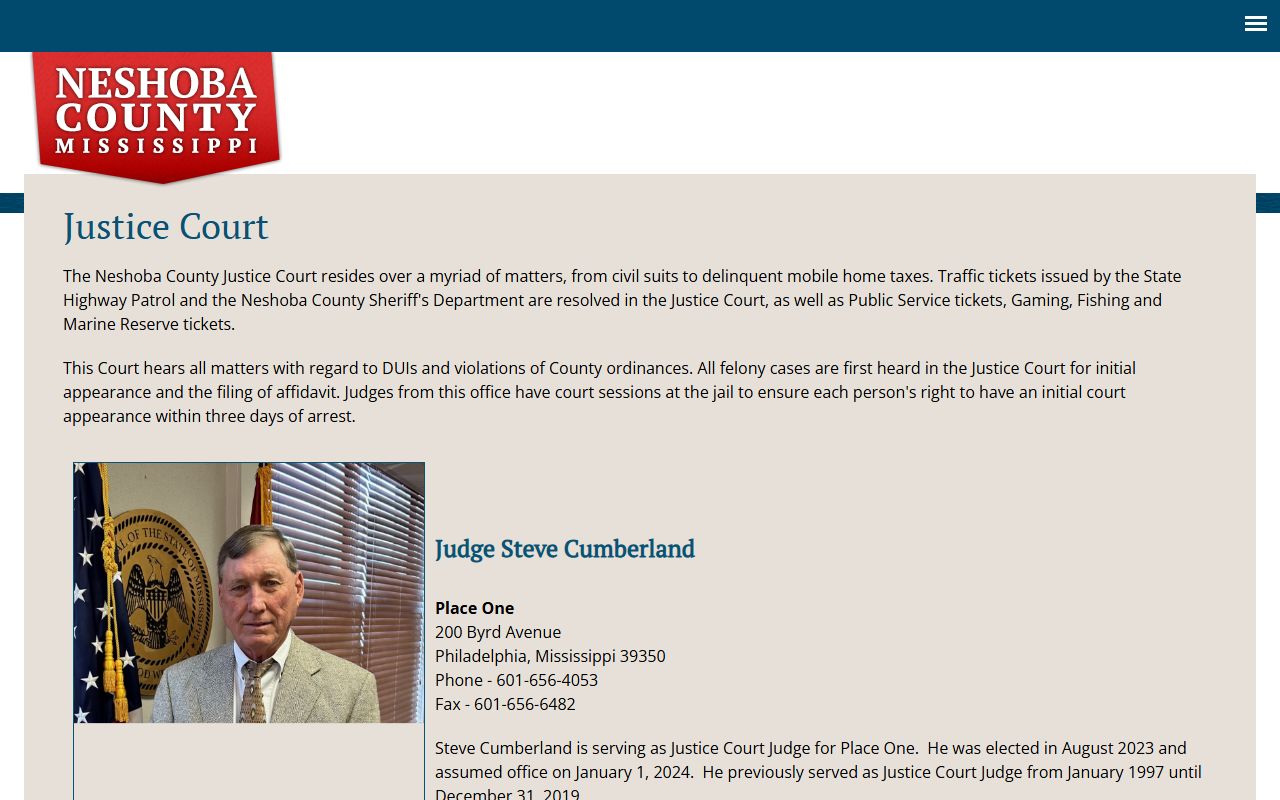
This detail is important because it gives Neshoba County a specific timing rule instead of a generic arrest-to-court timeline.
Find Neshoba County Court Records After Arrest
Start with the office that matches the case stage. Justice Court handles first appearances, misdemeanor and traffic matters, DUIs, ordinances, and felony affidavits at the beginning of a case. The Circuit Clerk receives and files lawsuits, indictments, motions, and related papers in Circuit or County Courts and keeps judgments and process. Mississippi Electronic Courts can provide digital case access, but it may require court selection, login, and paid or subscriber access for some documents.
- Identify whether the matter is still at first appearance, misdemeanor, DUI, ordinance, traffic, or early felony stage.
- Call or check Neshoba County Justice Court for early arrest-related court records and affidavit questions.
- Use the Circuit Clerk for felony indictments, Circuit Court criminal filings, motions, and judgments.
- Search Mississippi Electronic Courts when the case is available through that system and access requirements are met.
- Compare jail booking charges with formal court charges before drawing conclusions about the case.
The Circuit Clerk source confirms the criminal-case filing duties that matter once a felony case moves beyond the earliest Justice Court stage.
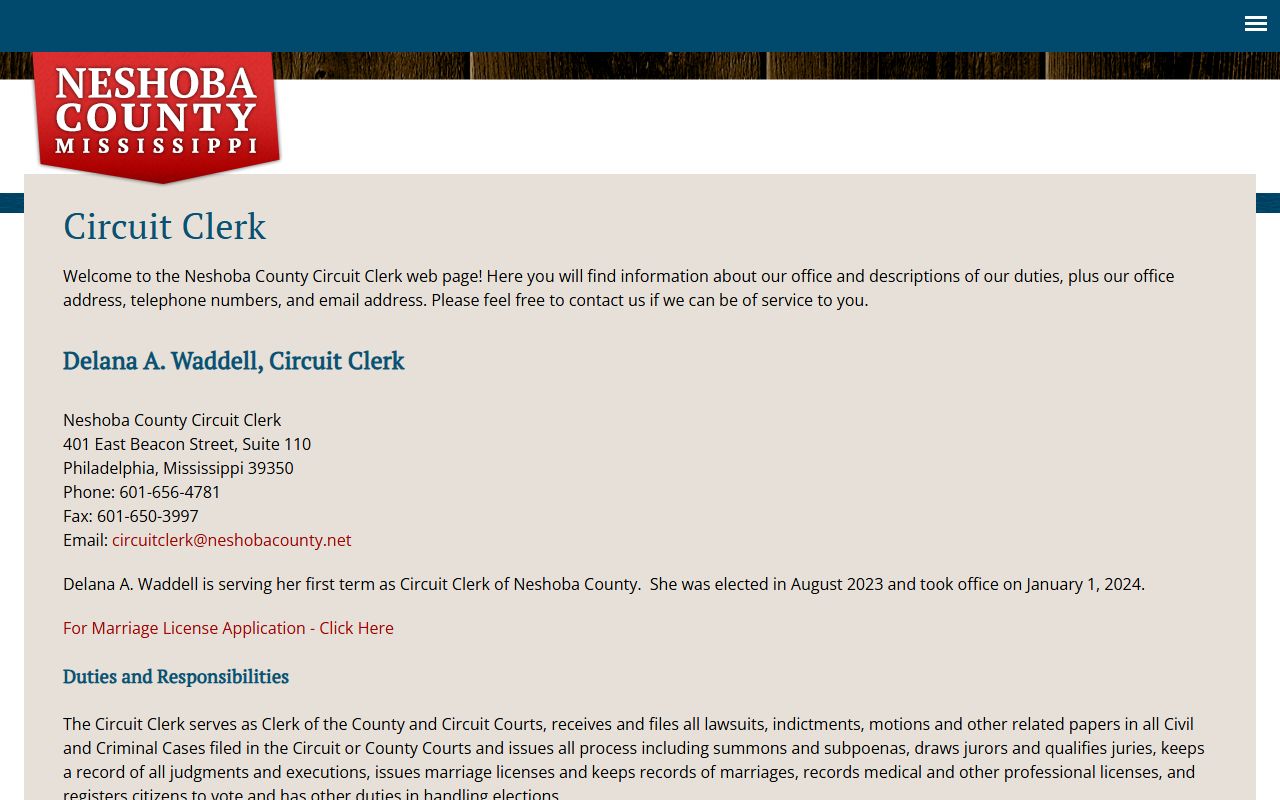
The clerk record path matters most for indictments, motions, judgments, and formal court records that are not simply jail custody entries.
Neshoba County Case Search Fields
The research found Mississippi Electronic Courts as the statewide court-record channel, but the public browser view did not expose a full case-search screen for Neshoba County without court selection or login. Treat MEC as a court-access system, not an open jail roster. If a case is too new for digital access, or if the person has only had an initial appearance, the Justice Court or Circuit Clerk may be the clearer first contact.
| Search Area | Type | Required | Notes |
|---|---|---|---|
| MEC court selection and login | Court access gateway | Yes | Select the court and login; access and fees may apply. |
| Defendant name | Likely case search field after access | Unspecified | Not fully captured in the public browser research. |
| Case number | Likely case search field after access | Unspecified | Use when the clerk or court notice provides a case number. |
| Justice Court contact | Office inquiry | n/a | Use for first appearance, affidavit, traffic, DUI, ordinance, and early felony questions. |
Neshoba County Arrest Charging Documents
After a Neshoba County arrest, the court record may begin with an affidavit in Justice Court. Felony matters can later move toward Circuit Court, where indictments, motions, and criminal filings are handled through the clerk. The District Attorney, Steven Kilgore for the Eighth Judicial District, prosecutes for the State in criminal matters arising under law. A booking allegation can change as the prosecutor reviews evidence, files formal charges, presents a case to a grand jury, or dismisses a count.
| Document | Who Uses It | What It Does |
|---|---|---|
| Affidavit or complaint | Officer, complainant, or prosecutor through Justice Court practice | Starts or supports the early criminal allegation after arrest. |
| Information | Prosecutor where permitted by procedure | States formal charges without using a grand-jury indictment in the cases where that route applies. |
| Indictment | Grand jury and Circuit Court process | Formal felony charging document filed with the Circuit Clerk after grand-jury action. |
Neshoba County Arrest Charge Status
Charge status can change many times after arrest. A jail booking line may list the arresting officer's initial allegation. Court records show what the court has accepted, what the prosecutor has filed, and how each count is moving. A charge may be pending, amended, reduced, dismissed, bound over, indicted, or resolved by plea or trial. Never read a booking charge as a conviction. The case outcome is found in court records, not in the fact of arrest.
| Status | What It Means |
|---|---|
| Pending | The court case or count is still open and has not reached final disposition. |
| Amended | The filed charge was changed, often to correct, add, reduce, or alter the allegation. |
| Bound over | An early felony matter moved from Justice Court toward Circuit Court review. |
| Indicted | A grand jury returned a formal felony charging document. |
| Dismissed | The court or prosecutor ended the charge without a conviction on that count. |
| Nolle prosequi | The prosecutor declined to pursue the charge, subject to the court's handling of the case. |
| Convicted | A plea or verdict resulted in a judgment of guilt. |
Neshoba County Arrest Bond Records
Neshoba County official online sources do not publish a jail bond schedule, accepted jail payment methods, or bond-window hours. The useful local rule is procedural: Justice Court handles initial appearances, and judges hold jail sessions so arrested people receive a first appearance within three days. Bond may be set there for local criminal matters, while Circuit Court may handle later felony proceedings if the case is bound over or indicted. Always confirm bond with the Law Enforcement Center, Justice Court, or counsel before paying, and treat the Justice Court fine-payment page as fine and citation guidance rather than jail-bond instructions.
| Bond Type | Local Record Point |
|---|---|
| Cash bond | No Neshoba jail payment schedule was published; call 601-656-1414 before payment. |
| Surety bond | Commercial bail practice may apply, but acceptance must be verified with court or jail. |
| Personal recognizance | A judge may order release on a promise to appear. |
| No-bond hold | Release is blocked until the court or holding agency clears the hold. |
| Outside detainer | Another county, MDOC, federal, ICE, probation, parole, or court hold may control release. |
Neshoba County Arrest Warrants
No official Neshoba County active warrant web search was found on the county website. The sheriff app and local app coverage describe a Most Wanted feature, so check the Neshoba County Sheriff MS app as an app feature, not as a complete warrant database. For warrant questions, use the Sheriff's Office or Law Enforcement Center, Justice Court for bench warrants and traffic, DUI, ordinance, or early felony issues, and the Circuit Clerk for felony filings and indictment-related records.
- Arrest warrant
- A judge-authorized order to take a person into custody.
- Bench warrant
- A court warrant often tied to missed court or violation of a court order.
- Search warrant
- Authority to search a place or item, not a public person-search roster.
- Capias
- Court process directing that a person be taken into custody.
Neshoba County Charges vs Convictions
An arrest charge is an accusation. A conviction is a later court outcome. This distinction is crucial in Neshoba County court records after a jail arrest because Justice Court may handle an initial affidavit before the prosecutor files or changes formal charges. A case can also be dismissed, reduced, bound over, indicted, or resolved without the same wording that appeared at booking.
| Point | Charge | Conviction |
|---|---|---|
| Stage | Allegation after arrest or filing | Final court judgment after plea or verdict |
| Proof | Based on accusation, affidavit, probable cause, or prosecution filing | Requires plea or proof beyond a reasonable doubt at trial |
| Record Meaning | Shows what was alleged or filed | Shows legal guilt on that count |
| Search Risk | Can be mistaken for guilt | Still must be read with sentence, appeal, and expunction status |
Neshoba County Sealed and Expunged Records
Mississippi expunction law controls when arrest and court records may be cleared or limited after a dismissal, dropped charge, no disposition, not-guilty outcome, or other eligible event. Mississippi Code section 99-19-71 is the key statute in the research. Expunction is not the same as asking an unofficial website to remove a listing. The court process should be checked through the clerk or counsel, and eligible orders must be followed by the offices holding the affected records.
| Point | Sealed | Expunged |
|---|---|---|
| Public view | Limited or hidden from ordinary public access. | Treated as cleared under the court order and statute. |
| Legal basis | Depends on court order and record type. | Depends on eligibility under Mississippi expunction law. |
| Best contact | Clerk or court handling the case. | Clerk, court, and counsel for the expunction petition and order. |
Restricted Neshoba County Court Records
Not every record connected to an arrest is open in the same way. Public records law provides access unless an exemption applies, but court records, juvenile matters, sealed files, expunged matters, ongoing investigations, victim information, medical information, and redacted identifiers can be treated differently. Neshoba County's public-records policy also separates county public records from records that must be obtained through court procedures. If a court record is missing, the reason may be timing, court access rules, sealed status, or a case that has not yet been filed in the office being searched.