
Neshoba County Inmate Population Overview
The main local custody point for the Neshoba County inmate population is the Neshoba County Law Enforcement Center, also called the Neshoba County Detention Center or Neshoba County Jail in county procurement material. It is operated by the Neshoba County Sheriff's Department and serves people arrested by the sheriff, Philadelphia Police Department, Mississippi Highway Patrol activity in the county, and other local agencies. The county page names Sheriff Eric Clark as sheriff and Amanda Wilkerson as jail administrator, which matters because Mississippi law makes the sheriff the county jailer and jail-docket keeper.
The regional part of the Neshoba County inmate population is different. Kemper/Neshoba County Regional Correctional Facility is in DeKalb, in neighboring Kemper County, and MDOC lists it as a regional facility. It holds state inmates, joint county-state inmates, and county inmates. Philadelphia Police Department is an arresting agency in the county seat, but official city sources do not publish a separate city jail roster or bed count. For city arrests, the custody check normally moves to the Neshoba County jail, court, or records request path.
The strongest local detail is the county jail building itself. The sheriff page says it opened in January 1995, was built in less than seven months, cost $1.8 million, and used factory-assembled welded steel detention units. Those facts help place the Neshoba County inmate population in a small county jail setting rather than a large prison setting.
Neshoba County Inmate Population Statistics
Official online county sources publish jail capacity but not a current average daily jail population. That is an important limit. The Neshoba County inmate population should not be described as overcrowded or under capacity without a current headcount from the jail or a public-records response. The county sheriff page gives a bed count for the Law Enforcement Center, while the Kemper sheriff page gives a separate regional capacity mix.
| Measure | Figure | Source / Year |
|---|---|---|
| Neshoba County jail capacity | 64 beds, with 52 maximum-security beds and 12 work-crew beds | Neshoba sheriff page, current county website copyright 2025 |
| Neshoba jail building size | Over 15,000 square feet | Neshoba sheriff page |
| Kemper/Neshoba Regional capacity | 480 beds, with 355 state, 50 joint county-state, and 75 county beds | Kemper County sheriff jail page |
| Neshoba County resident population | 29,087 in 2020 and 28,732 in 2025 | U.S. Census QuickFacts and FRED/Census series |
| Mississippi incarceration context | 1,020 per 100,000 residents across prisons, jails, immigration, and juvenile facilities | Prison Policy Initiative Mississippi profile |
Neshoba County Inmate Population Trends
The local trend line has a source gap. Research found no official county average daily population table, annual booking count, or average length-of-stay report for the Neshoba County inmate population. The correct way to handle that gap is to use the published capacity facts and seek current occupancy from the jail or through the written public-records process. A daily roster, if visible in the sheriff app, is not the same as a multi-year average.
| Year | Local ADP / Headcount | Notes |
|---|---|---|
| 2021 | Not published online | No official Neshoba jail ADP source located |
| 2022 | Not published online | No official Neshoba jail ADP source located |
| 2023 | Not published online | BJS reported 664,800 U.S. jail ADP nationally, not a Neshoba count |
| 2024 | Not published online | WTOK reported an ACA audit at Kemper/Neshoba Regional, not a county jail ADP |
| 2025 | Not published online | FRED/Census estimated county resident population at 28,732, not jail population |
Neshoba County Inmate Population Makeup
Official Neshoba sources did not publish a local breakdown by sex, age, race, pretrial status, felony status, or misdemeanor status. The jail docket law lists individual custody fields, but it does not create a public demographic dashboard. National benchmarks can add context only when they are labeled as national jail data. The BJS Jail Inmates in 2023 tables reported that 70 percent of the national jail population was unconvicted at midyear 2023 and that 75 percent was held for felony offenses.
That national BJS data should not be treated as the Neshoba County inmate population. It only shows why custody status matters. A person in the county jail may be awaiting first appearance, waiting for bond, serving a short local sentence, held for another agency, or waiting for transfer after sentencing. Once a person moves into state custody, the MDOC locator and MDOC records office become more useful than the county jail phone line.
The Neshoba County contact list shows the Law Enforcement Center and Sheriff's Office as the local custody contacts. For a current headcount or demographic report that is not posted online, the county public-records policy is the durable route.
Neshoba County Jail Capacity
The county jail is small beside the regional facility. The Neshoba County Law Enforcement Center has 64 documented beds, split between maximum-security beds and work-crew beds. The county jail also houses sheriff administrative offices, investigators, and deputies in the same building. That makes the Neshoba County inmate population highly tied to one local law-enforcement center in Philadelphia.
Kemper/Neshoba Regional is larger and has a different custody role. The Kemper sheriff page lists a 480-bed mix for state, joint county-state, and county inmates. An older Kemper sheriff release said the regional facility had capacity up to 497 and held 419 inmates at that time, but the current facility page uses the 480-bed mix. The two figures should not be blended. They come from different contexts and dates.
Capacity note: Capacity is published for both the county jail and regional facility, but a current Neshoba County jail population is not posted in the reviewed official sources.
Neshoba County Inmate Records Laws
Mississippi law gives the records framework behind the Neshoba County inmate population. The Mississippi Public Records Act policy statement says public records must be available for inspection unless a law says otherwise. Neshoba County's public-records policy applies that rule to county records and requires a written request with enough detail to identify the record.
Key statutes:
Miss. Code Ann. 25-61-1 says public access is the rule unless another law creates an exception.
Miss. Code Ann. 25-61-5, cited in the county policy, covers inspection, copying, and reproduction rights for public records.
Miss. Code Ann. 47-1-21 requires the sheriff to keep an alphabetical jail docket with custody fields.
Miss. Code Ann. 47-1-27 forbids maltreatment and willful failure to provide basic care to county prisoners.
Miss. Code Ann. 47-1-57 addresses medical aid and nurse screening for jailed people.
Search Neshoba County Inmates
No official browser-based Neshoba County jail roster was located on the county website. The official Neshoba County Sheriff MS mobile app is the researched roster channel because the store listings and local launch coverage advertise an Inmate Roster feature. If the app is not available, does not show the person, or does not show enough detail, call the Law Enforcement Center or use the written public-records process.
- Search the Apple App Store or Google Play for Neshoba County Sheriff MS.
- Confirm the publisher. Apple lists Neshoba County Sheriff's Office (MS), and Google Play lists OCV, LLC.
- Open the app and check the advertised Inmate Roster module for current custody.
- If the app does not answer the question, call the Law Enforcement Center at 601-656-1414.
- For older booking records or release details, submit a written public-records request through the county policy.
The Google Play listing for the Neshoba County Sheriff MS app is one of the app sources captured for this project.
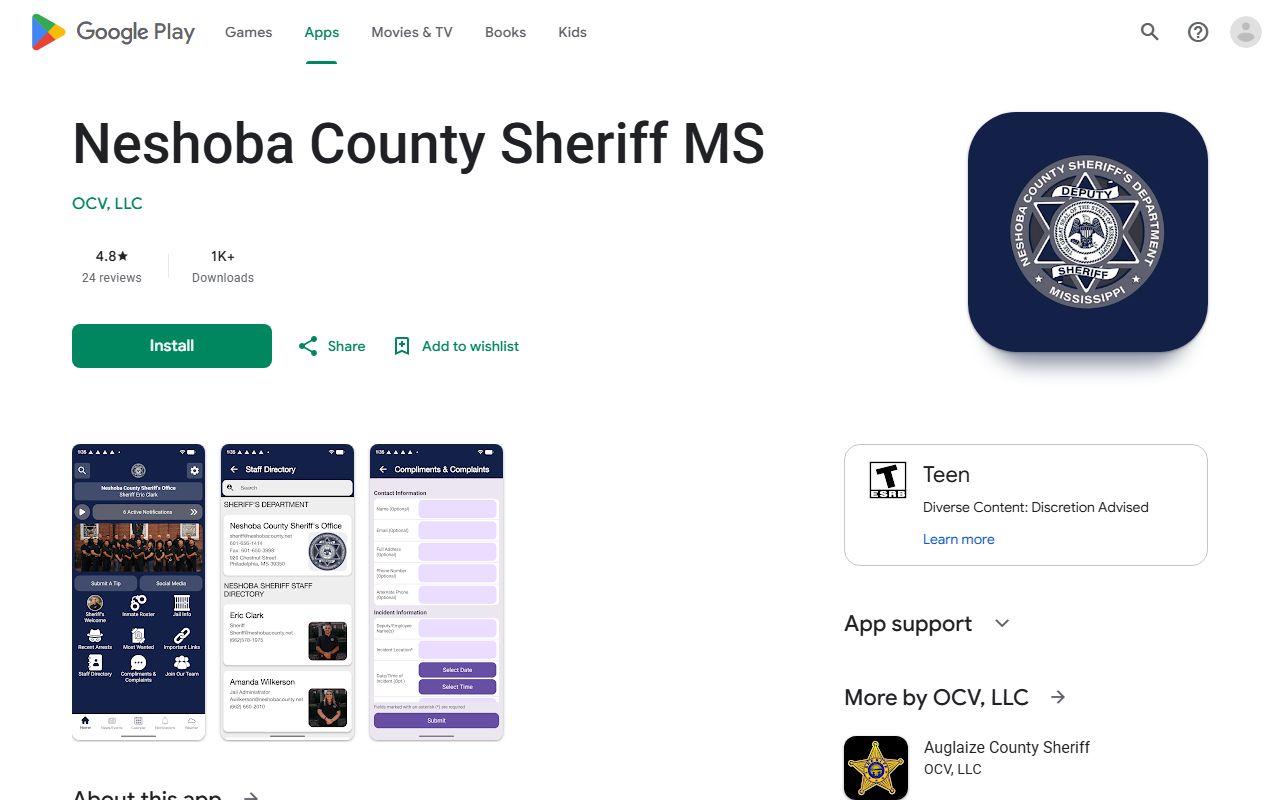
The app matters because research found the roster and most-wanted tools described as app features, not as standard pages on the county website.
Neshoba County Inmate Lookup Fields
The county web roster field table is empty because no official browser roster was found. The sheriff app fields could not be fully inspected in a browser. That means the safest Neshoba County inmate lookup directions are channel based: app first, jail phone next, then records request for documents that are not posted. For sentenced state prisoners, use the MDOC search fields instead.
| System | Field Label | Type | Required | Notes |
|---|---|---|---|---|
| Neshoba web roster | Not available | n/a | n/a | No official browser roster form found on neshobacounty.net |
| Sheriff app roster | Inmate Roster | Mobile app module | Unspecified | Feature advertised, but fields were not inspectable from browser |
| MDOC locator | Search Criteria | Radio | Yes | Name or ID Number |
| MDOC locator | Last Name | Text | Required for name search | First name can narrow results |
| MDOC locator | MDOC ID Number | Text | Required for ID search | Use after transfer to sentenced state custody |
Neshoba County Inmate Record Fields
Because the Neshoba app roster could not be inspected, the page should not promise that a public result shows a mugshot, charges, bond, housing unit, or release date. Mississippi's jail docket statute is the reliable field source. It requires the sheriff to keep an alphabetical docket with a person's name, age, color, sex, commitment date, time to serve, fines, costs, jail fees, work days, and discharge date.
| Field | What It Means |
|---|---|
| Name and age | Identity fields in the sheriff's required jail docket |
| Commitment date | The date the person was placed in jail custody |
| Time required to be served | Sentence or commitment time shown in the docket when applicable |
| Fine, costs, and jail fees | Financial entries required by the jail docket law |
| Work days | Days worked on county farm or work assignment, relevant because Neshoba has work-crew beds |
| Discharge date | The date the person left custody, if recorded and releasable |
Neshoba County Jail vs Prison Search
A Neshoba County jail record, an MDOC inmate profile, a BOP locator result, and an ICE ODLS result answer different questions. The county jail covers local pretrial and short-term custody. The MDOC locator covers sentenced Mississippi prisoners after transfer. BOP covers federal inmates from 1982 forward. ICE ODLS covers current adult immigration custody and certain CBP custody that lasts more than 48 hours.
| Custody Type | Where to Search | Best Use |
|---|---|---|
| Current county jail custody | Neshoba County Sheriff MS app, then Law Enforcement Center | Recent arrests, local holds, bond status, and current custody |
| Sentenced state custody | MDOC inmate search | Prison or regional custody after sentence |
| Release notifications | Mississippi VINE | Custody status notices and victim notification |
| Federal custody | BOP inmate locator | Federal prisoners from 1982 to present |
| Immigration custody | ICE Online Detainee Locator | Adult ICE detainees by A-number or name details |
Neshoba County Booking Record Requests
The records request process is important because no official web roster was found. Neshoba County's public-records policy names the Chancery Clerk/Public Records Officer as the written-request contact for county records. Requests must be in writing on the county form, or by letter, fax, or email. A request needs the requester's name, address, telephone or email, an adequate description of the record, and the date and time of the request. The policy says the officer or designee does not accept requests with those details by phone or in person.
Inspection hours are Monday through Friday, 8:00 a.m. to 5:00 p.m., excluding legal holidays, at the Chancery Clerk's office. Fees in the policy include $0.50 for a standard photocopy page, $0.75 for a color copy if available, $0.25 for scanning existing paper records, actual mailing costs, and possible search, review, and redaction costs based on the lowest-paid qualified employee's hourly compensation.
Note: Phone calls can confirm basic custody questions, but the county policy requires written requests for public records.
Neshoba County Detention Facilities
The facility list should stay narrow because no MDOC state prison, BOP facility, or ICE detention center was found physically inside Neshoba County. The Neshoba County inmate population still intersects with state, federal, and immigration systems through transfer, sentence, or detainer, but the local facility pages are limited to the county jail, the named regional facility, and the Philadelphia Police Department arresting agency.
- Neshoba County Law Enforcement Center / Neshoba County Detention Center - the sheriff-operated county jail for local pretrial custody, county inmates, and accepted inmates from other government entities.
- Kemper/Neshoba County Regional Correctional Facility - a regional correctional facility in DeKalb with state, joint county-state, and county inmates.
- Philadelphia Police Department - a municipal police agency and arrest point, not a published public jail roster.
Neshoba County Custody Terms
Short definitions help separate jail, court, and prison records. These words appear in local custody searches, Justice Court questions, and public-records requests.
- Booking
- Administrative intake after arrest, including identity checks, property steps, and custody record creation.
- Jail docket
- The sheriff's required custody record under Mississippi law.
- First appearance
- An early judge review. Neshoba Justice Court says jail sessions protect the right to an initial appearance within three days of arrest.
- Detainer
- A hold from another authority, such as another county, MDOC, federal court, or immigration custody.
- Expunction
- A statutory clearing or sealing process under Mississippi law for qualifying cases.
Neshoba County Inmate Population FAQ
Is there a Neshoba County web jail roster?
No official browser-based Neshoba County jail roster was located on the county website. Research points to the official Neshoba County Sheriff MS app as the roster channel, with the Law Enforcement Center and written records request process as fallbacks.
How large is the Neshoba County inmate population?
The county publishes a 64-bed jail capacity, but not a current online average daily population. Kemper/Neshoba Regional publishes a separate 480-bed capacity mix. Current occupancy should be confirmed with the facility or by records request.
Where are sentenced Neshoba County inmates searched?
Sentenced Mississippi prisoners should be searched through MDOC, not the county jail app alone. MDOC accepts name or ID number searches, and MDOC Records handles questions about time, jail credit, and eligibility dates.
Can VINE replace a jail roster?
No. Mississippi VINE is a custody-status and notification tool. It is useful for release alerts, but it does not replace the jail, MDOC locator, court clerk, or written records process.
Do federal or ICE detainees appear in county records?
A local booking may show a federal or immigration hold if the jail can release that detail, but federal prison and immigration custody use separate systems. Search BOP for federal prisoners and ICE ODLS for adult immigration detainees.